|

How Laser Therapy Works
Science & education
How laser therapy works.
Heat is like pushing a door open. Laser is like turning the handle. It doesn’t overwhelm tissue — it communicates with it.
When most people think about treating pain or fat, the solutions fall into familiar categories: heat it, freeze it, medicate it, remove it. Each acts on the tissue — often aggressively — to force a response. Low-level laser therapy does something different. Instead of heat or force, it uses specific wavelengths of light to interact with the body at the cellular level, signaling the body to respond on its own.
- Non-thermal
- Photochemical, not photothermal
- 635 · 520 · 405 nm
- First FDA clearance, 2002
- 25 clearances
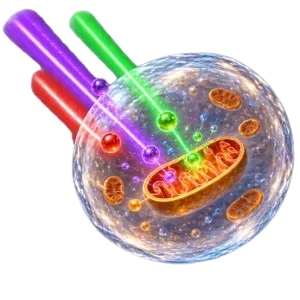
Not a thermal reaction. A photonic interaction.Cells absorb the light, mitochondrial activity is influenced, and cellular processes become more active — without damaging tissue.
2002
Erchonia becomes the first company to receive FDA clearance for low-level laser therapy
25
FDA clearances since, each on a double-blind, randomized, placebo-controlled trial
3
wavelengths — red, green and violet — each chosen for the chromophore it targets
0
heat, tissue damage, drugs or downtime
The problem with traditional approaches
Force the tissue — or signal it?
The familiar options act on the body from the outside. Laser therapy asks the body to do the work.
01
Heat it
Thermal devices warm tissue to drive circulation. The effect is real, temporary and dose-limited by the heat itself — the same energy that helps can burn.
02
Freeze it
Cold destroys what it touches. It is a blunt instrument for a precise problem, with the recovery that destruction implies.
03
Medicate it
Drugs quiet the signal without addressing the tissue, and bring side effects and interactions with them.
04
Remove it
Surgery takes the problem out — along with the tissue around it, and the downtime that follows.
But what if, instead of forcing change, you could signal the body to respond on its own?
The Erchonia breakthrough
Light alone. Measurable outcomes.
In 2002, Erchonia became the first company to receive FDA clearance for low-level laser therapy.
At the time, the idea that light alone — without heat — could influence biological processes was still emerging. Through controlled clinical studies, Erchonia demonstrated something important: specific wavelengths of light could produce measurable outcomes without damaging tissue. That shifted laser therapy from theory into clinical reality, and it set the standard the company has held since — its indications established on double-blind, randomized, placebo-controlled trials, the highest standard in clinical testing, and one most cleared devices never meet.
| Diode | Photon energy | What it targets | Where you find it |
|---|---|---|---|
| 635 nm red | ~1.95 eV | Cytochrome c oxidase (Complex IV) — ATP production; neck, shoulder, low back and postoperative pain | XLR8 · EVRL · FX 635 · FX 405 |
| 520 nm green | ~2.38 eV | Complex III of the electron transport chain — ROM and pain improvement demonstrated in a single session | GVL |
| 405 nm violet | ~3.06 eV | The most energetic photon in the line; ROS signaling; anti-microbial; moderate inflammatory acne | EVRL · GVL · FX 405 |
Power counts photons. Energy is what each photon can do. Erchonia builds high-energy lasers, not high-powered ones.
What happens at the cellular level
Inside every cell are mitochondria.
They produce ATP — the energy that powers cellular activity. Laser therapy speaks to them directly.
01
Absorption
Photons are absorbed by chromophores in the cell — chiefly cytochrome c oxidase in the mitochondria. Absorption is wavelength-specific, which is why Erchonia engineers discrete violet (405 nm), green (520 nm) and red (635 nm) diodes rather than broad-spectrum output.
02
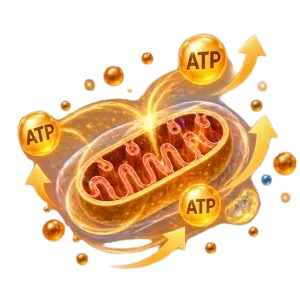
Energy production
Absorption drives ATP synthesis upward — the treated cell has more energy available for signaling and regulation.
03
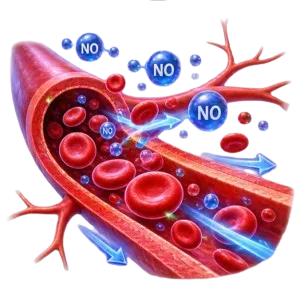
Signaling
The same event releases nitric oxide and a brief pulse of reactive oxygen species — signaling molecules that shift gene expression in the treated cell.
04
A response beyond the beam
These signaling mediators move beyond the treatment site, so measured effects aren’t confined to the spot under the laser — a systemic response to a local, precisely placed stimulus.
A simple way to visualize it
The factory with the lights on.
Think of a factory with the lights on but the machines running slowly.
The structure is intact. The systems are in place. But production is limited. Laser therapy doesn’t rebuild the factory — it helps the machines run at full capacity again. That is why the effect is not confined to the spot under the laser, why there is nothing to recover from, and why the same mechanism serves the sore shoulder, the surgical incision and, in the fat-loss lasers, the adipocyte that is signaled to release what it stores.
It is not a thermal reaction. It is a photonic interaction.
Go deeper
The science, in three chapters.
01
FDA clearances
Each indication Erchonia holds, the year it was earned and the evidence behind it — from the 2002 neck-and-shoulder clearance forward.
02
Low-level laser therapy
What “low-level” means, why the dose window matters, and how photobiomodulation differs from every thermal modality.
03
Laser classifications
Class 2, Class 3B, Class 4 — what the hazard classes actually describe, and why Erchonia builds at the low-power end on purpose.
Next step
See it in one visit.
The fastest way to understand a non-thermal laser is to watch a range-of-motion change in a single session. Book a demo.