|


Wound healing is essential for recovery after injury, surgery, burns, and chronic skin damage, yet the process is not always efficient. Factors such as aging, diabetes, poor circulation, and inflammation can interfere with normal tissue repair, prolonging recovery and increasing the risk of complications.
As interest in supportive, non-invasive therapies grows, low-level laser therapy (LLLT), also known as photobiomodulation, is gaining attention in wound management. Using specific wavelengths of light, this approach aims to stimulate cellular activity and support the body’s natural healing response. Today, LLLT is increasingly being explored alongside standard wound care in both clinical and rehabilitation settings.
The Challenge of Slow or Chronic Wounds
Chronic and slow-healing wounds remain a major challenge for both patients and healthcare professionals. Conditions such as diabetic foot ulcers, venous leg ulcers, pressure injuries, burns, and post-surgical wounds can take weeks or months to heal, especially when blood flow, immune response, or tissue regeneration is impaired.
Delayed healing increases the risk of infection, scarring, repeated hospital visits, and reduced quality of life. Although standard treatments such as dressings, antibiotics, and debridement are essential, some wounds respond poorly despite ongoing care.
In these cases, the skin struggles to progress through the normal stages of healing, including inflammation, tissue formation, and remodeling. This has increased interest in adjunct therapies such as laser therapy for wound healing, which aims to support tissue regeneration and recovery at a cellular level.
What Is Low-Level Laser Therapy (LLLT)?
Low-Level Laser Therapy (LLLT), also known as cold laser or photobiomodulation, is a non-invasive treatment that uses low-intensity light to stimulate cellular activity. Unlike surgical or high-power lasers, it does not cut or heat tissue. Instead, it works at the cellular level to promote healing.
In laser therapy for wound healing, the light is typically delivered in specific wavelengths that penetrate skin and interact with mitochondria, the energy-producing structures in cells. This triggers biological responses that support repair and regeneration.
How Low-Level Laser Therapy Supports Wound Healing
Low-level laser therapy (LLLT) supports wound healing by stimulating cellular processes involved in tissue repair without cutting or heating the skin. The light energy penetrates the wound area and interacts with cells involved in healing, helping create a more efficient repair environment.
Increased Cellular Energy (ATP Production)
LLLT stimulates mitochondrial activity, increasing ATP production and providing cells with more energy for repair and regeneration. Clinical studies on diabetic ulcers and post-surgical wounds have associated this effect with faster wound closure and improved healing progression compared to standard care alone.
Improved Blood Circulation
Photobiomodulation may enhance microcirculation and vasodilation, improving oxygen and nutrient delivery to damaged tissue. This is especially important in chronic wounds such as diabetic and venous ulcers, where blood flow is often compromised.
Reduced Inflammation
Research suggests LLLT can help regulate inflammatory activity around wounds, reducing tissue stress and discomfort. Some studies also report lower pain levels during healing when laser therapy is added to conventional care.
Enhanced Collagen and Tissue Formation
LLLT may stimulate fibroblast activity, collagen synthesis, and granulation tissue formation. These processes support stronger tissue repair, improved healing quality, and, in some cases, reduced scarring.
Overall, current evidence supports the use of laser therapy for wound healing as a useful adjunct to standard wound care rather than a replacement for conventional treatment.
Clinical Uses of Laser Therapy for Wound Healing and Recovery
Low-level laser therapy is widely used in physiotherapy clinics, podiatry practices, wound care centers, sports medicine, and post-surgical rehabilitation. It is typically applied as an adjunct to standard wound care rather than a standalone treatment.
In practice, common applications include:
- Post-surgical recovery to reduce swelling and inflammation at the incision site
- Diabetic wound care to support granulation tissue formation
- Rehabilitation settings to improve mobility and healing outcomes
- Sports injury management to aid soft tissue recovery
For example, in orthopedic rehabilitation, a cold laser may be used after surgery, alongside dressings and physiotherapy, to support recovery and reduce inflammation. In diabetic wound care, clinicians often combine LLLT with dressing changes, pressure offloading, and infection control.
Clinicians may observe improved granulation tissue formation, reduced wound size, and more efficient healing progression compared to standard care alone, though outcomes vary. The strength of the evidence also differs by wound type, as summarized below:
| Wound type | Typical adjunct role | Evidence at a glance |
| Diabetic foot ulcers | Alongside offloading, dressings, and infection control | Most supportive: several meta-analyses report higher healing rates, though trials are small and parameters vary
|
| Venous leg ulcers | Alongside compression therapy and dressings | Limited and inconsistent; a Cochrane review found no clear benefit
|
| Pressure injuries | Alongside offloading and standard wound care | Mixed and limited; not well established
|
| Post-surgical / acute wounds | To support incision healing and reduce swelling | Some positive trials, but evidence is smaller in scale and mixed
|
| Burns | Alongside standard burn care | Emerging and limited; used cautiously
|
What to Expect During a Laser Therapy Session for Wound Healing
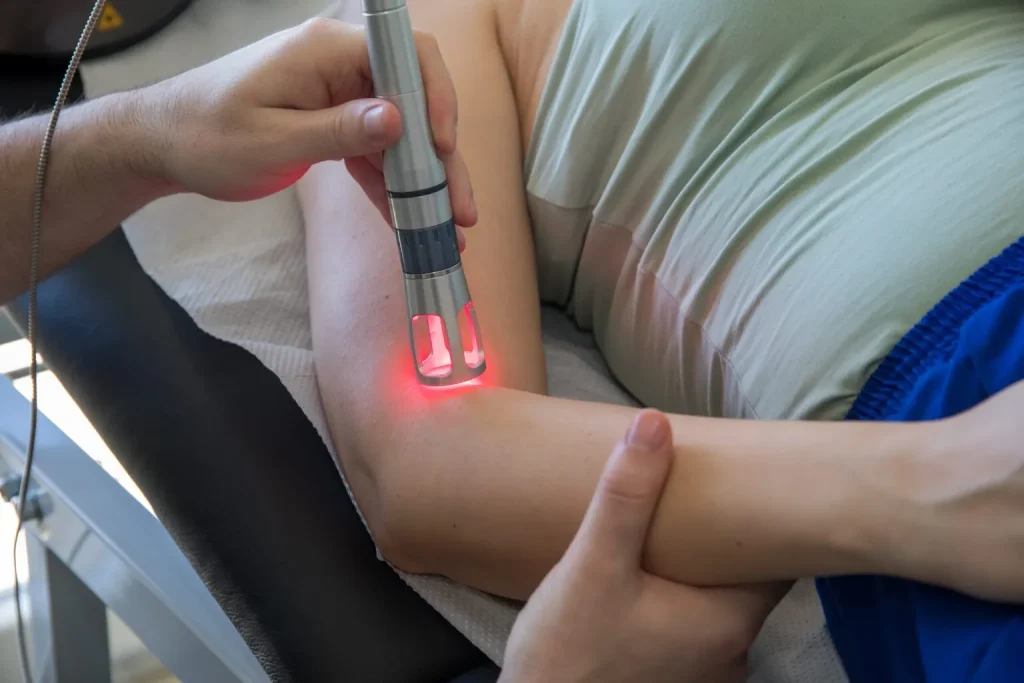
Laser therapy for wound healing is a simple, non-invasive procedure performed by a trained clinician.
During a typical session:
- A handheld laser device is applied over or around the wound area
- Low-level light is delivered to specific zones for a few minutes each
- Sessions usually last 5–20 minutes
- No anesthesia is required
Most patients feel little or nothing during treatment. Some may notice mild warmth or relaxation around the area.
There is no downtime, and normal wound care continues alongside treatment, making it easy to integrate into existing care plans.
Safety and Limitations of Low-Level Laser Therapy
Low-level laser therapy is generally safe when applied by trained professionals, as it does not damage tissue or produce heat that burns the skin. Side effects are rare but may include mild redness or temporary sensitivity.
It should be avoided in the following cases:
- Over untreated malignancies
- Directly over the eyes,
- In cases of active infection, without proper assessment.
Safety considerations include:
- Use of correct wavelength and dosage
- Professional supervision during treatment
Integrating Laser Therapy into Standard Wound Care
One of the key advantages of LLLT is that it integrates easily with existing medical treatment. It is commonly used alongside:
Commonly integrated with:
- Wound dressings and topical care
- Antibiotic therapy (if needed)
- Debridement procedures
- Compression therapy for venous ulcers
- Systemic management of conditions such as diabetes or vascular disease
This combined approach helps address both local tissue repair and underlying physiological barriers to healing. In patients with poor circulation or stalled wound progression, photobiomodulation may provide an additional biological stimulus alongside standard care.
Clinicians exploring advanced adjunct technologies often consider established systems such as those developed by Erchonia, which focus on non-invasive laser applications designed to support tissue healing within structured clinical protocols.
Conclusion
Low-level laser therapy offers a science-based, non-invasive approach that supports the body’s natural wound healing process. By enhancing cellular energy production, improving circulation, reducing inflammation, and promoting tissue regeneration, LLLT has shown potential as a valuable adjunct in the management of both acute and chronic wounds.
While it is not a replacement for standard wound care, evidence and clinical practice suggest it may improve healing outcomes when used alongside established treatments. As interest in regenerative and technology-driven care continues to grow, photobiomodulation is becoming an increasingly relevant tool in modern wound management.
For clinicians, systems such as those developed by Erchonia reflect the direction of this evolving, evidence-informed approach to tissue repair and recovery.
To find an Erchonia provider near you or discuss clinical laser systems, contact Erchonia.
FAQs
Q1. Does laser therapy help wounds heal faster?
Low-level laser therapy (LLLT) may support wound healing by increasing cellular energy, improving circulation, reducing inflammation, and promoting collagen formation. Evidence is strongest for diabetic foot ulcers, where several meta-analyses report higher healing rates as an adjunct to standard care, while results are more limited for other wound types. It is used alongside standard wound care, not as a replacement.
Q2. What types of wounds can low-level laser therapy help with?
LLLT is commonly used as an adjunct for chronic and slow-healing wounds such as diabetic foot ulcers, venous leg ulcers, pressure injuries, burns, and post-surgical wounds, especially where blood flow or tissue regeneration is impaired. The supporting evidence is strongest for diabetic foot ulcers.
Q3. Is low-level laser therapy safe for wound healing?
LLLT is generally safe when applied by trained professionals because it does not damage tissue or burn the skin. Side effects are rare and may include mild redness or temporary sensitivity. It should be avoided over untreated malignancies, directly over the eyes, and over active infections without proper assessment.
Q4. How long does a laser therapy session for wound healing take?
A typical session lasts about 5 to 20 minutes, during which a handheld laser device is applied over or around the wound. No anesthesia is needed, there is no downtime, and normal wound care continues alongside treatment.
Q5. Can low-level laser therapy reduce scarring?
LLLT may stimulate fibroblast activity and collagen synthesis, which in some cases is associated with improved healing quality and reduced scarring. Results vary, and it is used as an adjunct to standard wound care rather than a guaranteed scar treatment.
Q6. Can laser therapy replace standard wound care?
No. LLLT is an adjunct that supports the body’s natural healing process, not a replacement for standard wound care. It is used alongside dressings, debridement, infection control, compression therapy, and management of underlying conditions such as diabetes.


